CLAT Exam Syllabus: Comprehensive Subject-Wise Breakdown, Weightage & Preparation Guide
Explore all five UG CLAT sections, important topics, exam pattern, section-wise weightage and preparation strategies.
⬇ Download CLAT Syllabus PDFGet the syllabus PDF and start planning your preparation.
Introduction to the CLAT Exam Syllabus
Having a good understanding of the CLAT exam format, pattern and marking system can help candidates prepare effectively for the Common Law Admission Test (CLAT). The exam is conducted by the Consortium of National Law Universities (NLUs) for admission to undergraduate law programmes such as BA LLB and BBA LLB, as well as postgraduate LLM programmes.
This guide provides an overview of the CLAT syllabus, important subject-wise topics, section-wise weightage and practical preparation recommendations to help candidates plan their studies.
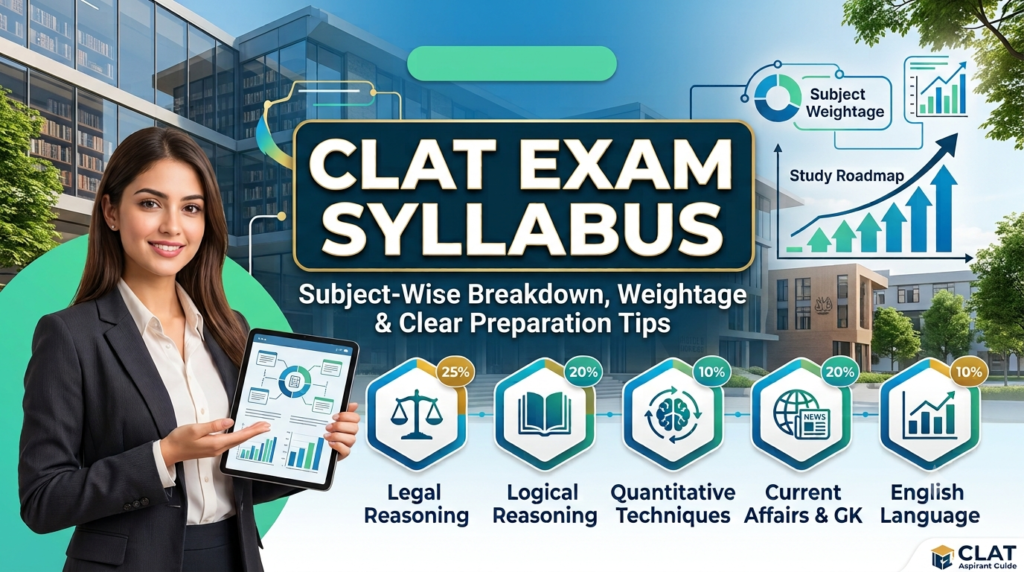
CLAT Exam Pattern & Section-Wise Weightage at a Glance
The UG CLAT examination is conducted over two hours in an offline, pen-and-paper format. The paper contains 120 objective-type multiple-choice questions.
Candidates receive one mark for each correct answer, while each incorrect answer attracts a penalty of 0.25 marks. There is no penalty for an unanswered question.
The paper uses reading passages, generally around 300–450 words for several sections, followed by multiple-choice questions that test comprehension, reasoning and application.
CLAT Section-Wise Weightage
| Subject / Section | Questions | Weightage | Primary Focus |
|---|---|---|---|
| Legal Reasoning | 28–32 | 25% | Legal principles and factual situations |
| Current Affairs & GK | 28–32 | 25% | News, major events and relevant background |
| Logical Reasoning | 22–26 | 20% | Arguments, inferences and assumptions |
| English Language | 22–26 | 20% | Comprehension, vocabulary and tone |
| Quantitative Techniques | 10–14 | 10% | Basic arithmetic and data interpretation |
| Total | 120 | 100% | 120 Maximum Marks |
Detailed Section-Wise CLAT Syllabus Breakdown
1. Legal Reasoning
The Legal Reasoning section evaluates a candidate's ability to understand legal principles and apply them to hypothetical situations. Extensive prior legal knowledge is generally not required, as passages provide the information needed to answer many questions. Familiarity with basic legal concepts can improve understanding.
Important Topics:
- Law of Torts: Negligence, vicarious liability, defamation, absolute liability and strict liability.
- Law of Contracts: Offer and acceptance, void agreements and breach of contract.
- Criminal Law: Actus reus, mens rea and general exceptions in criminal law.
- Constitutional Law: Fundamental Rights, Directive Principles, parliamentary procedures and landmark judgments.
- Current Legal Issues: Recent Supreme Court decisions, new laws and amendments to existing laws.
2. Current Affairs & General Knowledge
This section assesses awareness of important national and international events and the background needed to understand them. Preparation can include news reports, editorials and reliable current-affairs resources.
Main Topics Include:
- National & International Issues: Major treaties, summits such as G20 and BRICS, United Nations developments and government initiatives.
- Legal & Judicial Developments: Important Supreme Court decisions, constitutional amendments and legal developments.
- Governance & Economy: Union Budget, RBI developments, economic indicators and international trade.
- Arts, Culture & History: Significant cultural events, historical developments and important personalities.
- Science & Technology: ISRO missions, artificial intelligence developments and environmental agreements.
3. Logical Reasoning
Logical Reasoning evaluates the ability to understand arguments, analyse information and draw conclusions from written passages. Questions often test critical thinking rather than memorisation.
Key Areas:
- Critical Thinking: Identifying arguments, premises, conclusions and assumptions.
- Argument Analysis: Finding strengths and weaknesses in arguments, recognising fallacies and evaluating reasoning.
- Inference & Conclusions: Drawing conclusions supported by the information provided in a passage.
- Analytical Reasoning: Comparing information, examining cause-and-effect relationships and identifying connections between statements.
4. English Language
The English Language section measures reading comprehension, the ability to interpret written information and understanding of words in context. Candidates should practise reading passages carefully and identifying the main idea, supporting details and the author's point of view.
Topics Covered:
- Reading Comprehension: Answering questions based on facts, ideas and conclusions derived from a text.
- Author's Attitude & Tone: Identifying whether the author is neutral, critical, supportive, persuasive or expressing a particular viewpoint.
- Vocabulary in Context: Understanding the meanings of words and expressions as used in a passage.
- Grammar in Context: Understanding grammatical expressions and sentence structures through contextual usage.
5. Quantitative Techniques
This section presents numerical information through data sets, caselets, tables and charts. Candidates need to interpret the information and perform calculations using fundamental mathematical concepts generally associated with school-level mathematics.
Key Topics:
- Data Interpretation: Caselets, bar graphs, pie charts, line graphs and data tables.
- Core Arithmetic: Percentages, ratios, proportions, profit and loss, averages, time and work, speed and distance.
- Basic Mensuration & Mathematics: Simple equations and basic formulas for area and volume, where relevant to the prescribed syllabus.
Download the CLAT Exam Syllabus PDF
Keep the syllabus handy while preparing. Use the PDF as a reference when planning subject-wise revision and mock tests.
Download CLAT Syllabus PDF →Expert Preparation Tips to Crack CLAT
Master Reading Speed & Endurance
CLAT requires candidates to read and interpret multiple passages under time pressure. Practise reading editorials from established newspapers such as The Hindu and The Indian Express. Focus on comprehension, retention and identifying the main argument rather than speed alone.
Prioritise High-Weightage Sections
Legal Reasoning and Current Affairs together account for approximately half of the paper under the indicative distribution shown above. Build a daily current-affairs habit and regularly practise legal passages, while continuing to prepare for all five sections.
Develop a Targeted Mock Test Strategy
Attempt full-length mock tests under timed conditions. Review incorrect answers, identify weak areas and track your accuracy. Practise making informed decisions about when to attempt or leave a question to manage the −0.25 negative-marking penalty.
Frequently Asked Questions (FAQs)
1. Is there negative marking in CLAT?
Yes. Each correct answer carries one mark, and each incorrect answer attracts a penalty of 0.25 marks. No marks are deducted for unanswered questions.
2. Does CLAT include high-school mathematics?
The UG CLAT Quantitative Techniques section focuses on elementary mathematical concepts, including percentages, ratios and data interpretation. Candidates should refer to the official syllabus for the applicable examination year.
3. Are static GK questions asked in CLAT?
The Current Affairs and General Knowledge section uses current-affairs-based material. Relevant background knowledge can help candidates understand the passages and answer related questions. Prepare major events along with their important historical, political, legal and economic context.
Start Your CLAT Preparation with a Clear Plan
Understand the syllabus, practise reading comprehension, follow current affairs and take regular mock tests. A consistent, well-planned preparation strategy can help you improve accuracy and confidence.
Get the CLAT Syllabus PDFNote: The section-wise question counts and weightages in this article are indicative. Check the latest official CLAT notification and syllabus published by the Consortium of National Law Universities for authoritative examination details.