CLAT Exam Pattern 2027
Check the CLAT Exam Pattern 2027, including the number of questions, marking scheme, exam duration, section-wise weightage and preparation strategy.
Every aspirant who is preparing to appear for Common Law Admission Test and dreams of becoming a law student must be aware of the CLAT 2027 exam pattern. Exam Pattern helps in planning out the preparation and in understanding the importance of each section of the exam paper.
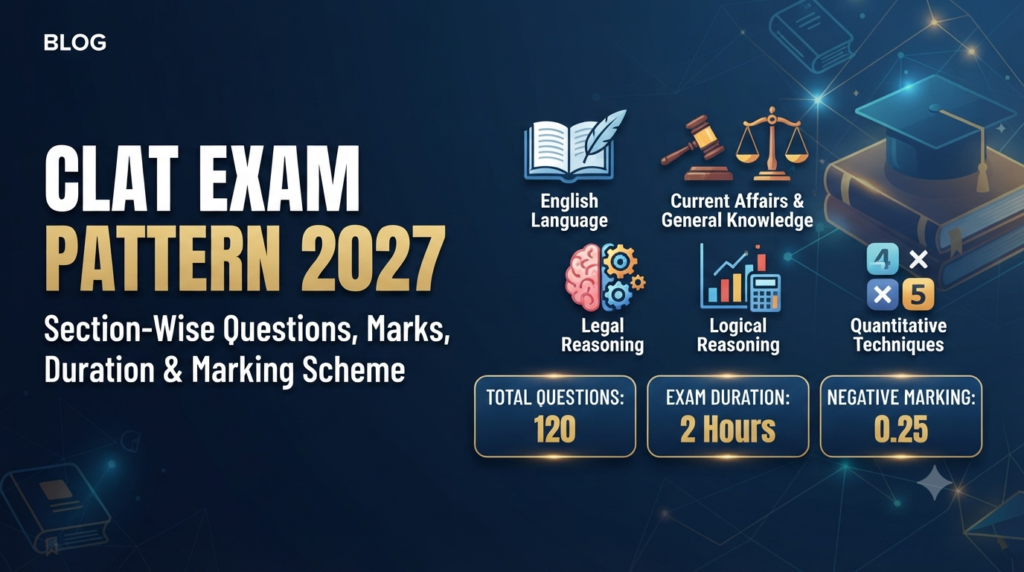
The Consortium of National Law Universities (NLUs) runs CLAT to give students a chance to join law programs at universities. The CLAT 2027 UG exam will be the time of 2 hours. The CLAT 2027 UG exam paper will be consisting of 120 marks and 120 multiple choice questions.
CLAT Exam Pattern 2027 - CLAT Paper Pattern 2027: Here is a guide to CLAT exam pattern 2027 with the details of how the paper is scored each section wise, number of questions, marks, exam time and other important points to keep in mind while appearing for the exam.
CLAT Exam Pattern 2027: Highlights
Candidates can check the details of the CLAT 2027 UG exam pattern below.
| Particular | Details |
|---|---|
| Exam Name | Common Law Admission Test (CLAT) |
| Exam Year | 2027 |
| Exam Level | National Level |
| Exam Mode | Offline |
| Type of Questions | Multiple Choice Questions |
| Total Questions | 120 |
| Maximum Marks | 120 |
| Exam Duration | 2 Hours |
| Total Sections | 5 |
| Marks for Correct Answer | +1 |
| Negative Marking | -0.25 for each wrong answer |
| Marks for Unanswered Question | 0 |
| Medium | English |
According to the CLAT 2027 UG question paper format, the exam will include 120 questions. Each question will carry one mark. For every wrong answer, 0.25 marks will be deducted.
CLAT Exam Pattern 2027: Section-Wise Weightage
The CLAT UG question paper has five sections: English Language, Current Affairs (Including General Knowledge), Legal Reasoning, Logical Reasoning and Quantitative Techniques. Each section contributes marks to the total marks of the exam.
English Language includes reading comprehension and grammar. Current Affairs including General Knowledge covers current national and international affairs. Legal Reasoning checks the ability to interpret principles. Logical Reasoning looks at critical thinking skills. Quantitative Techniques assesses mathematical and data interpretation skills.
| CLAT Section | Approx. Questions | Approx. Weightage |
|---|---|---|
| English Language | 22–26 | 20% |
| Current Affairs Including General Knowledge | 28–32 | 25% |
| Legal Reasoning | 28–32 | 25% |
| Logical Reasoning | 22–26 | 20% |
| Quantitative Techniques | 10–14 | 10% |
| Total | 120 | 100% |
The exact number of questions can change within the ranges, but the test will have 120 questions in total.
1 English Language
The English Language section carries approximately 20% of the CLAT paper, with around 22–26 questions.
Questions generally test a candidate's ability to understand and analyse passages. Candidates should focus on:
- Reading comprehension
- Main idea and central theme
- Inference-based questions
- Vocabulary in context
- Tone and purpose
- Summary and conclusions
- Comparison of ideas
2 Current Affairs Including General Knowledge
The Current Affairs and General Knowledge content constitutes 25% of the exam, with an estimated 28–32 questions.
It's important for candidates to be aware of events happening within the country and globally. Candidates can do so by reading news from authentic sources and being mindful of major happenings in politics, economy, science and global affairs.
Consistently reading newspapers, magazines and reliable sources can help develop solid knowledge. Focus on the current events of the last 6 months to 1 year. Make notes and revise regularly for better memorization.
- National current affairs
- International events
- Government schemes
- Important appointments
- Awards and honours
- Sports events
- Economic developments
- Legal and constitutional developments
- Important reports and indexes
- Major international organisations
3 Legal Reasoning
Legal Reasoning is one of the sections in the CLAT exam pattern 2027. Legal Reasoning carries 25% weightage and contains about 28–32 questions.
Legal Reasoning primarily tests how well candidates can understand principles and apply them to given situations or passages.
Important areas for preparation include:
- Legal principles
- Application of principles to facts
- Constitutional concepts
- Fundamental rights
- Important legal developments
- Contemporary legal issues
- Basic understanding of the Indian legal system
Candidates should focus more on reasoning and application rather than trying to memorise large amounts of legal information.
4 Logical Reasoning
The Logical Reasoning part makes up 20% of the CLAT exam paper and there are roughly 22–26 questions in this section.
This part tests the ability to think clearly and reason well.
Important areas include:
- Arguments
- Assumptions
- Conclusions
- Inferences
- Strengthening and weakening arguments
- Cause and effect
- Statements and conclusions
- Critical reasoning
- Relationships between ideas
Regular practice matters because working on these questions helps you get better at solving them correctly. With consistent practice, students can recognize patterns and build confidence.
5 Quantitative Techniques
Quantitative Techniques is the section with the lowest weightage among the five sections. It makes up about 10% of the paper and has roughly 10–14 questions.
Candidates need to concentrate on mathematical concepts and how to use them in questions involving data.
Important topics may include:
- Percentages
- Ratios and proportions
- Averages
- Profit and loss
- Simple and compound interest
- Basic algebra
- Data interpretation
- Tables and charts
- Number-based problems
Because this section has fewer questions, candidates should aim for high accuracy and manage time carefully.
CLAT Marking Scheme 2027
The CLAT 2027 Undergraduate examination follows a straightforward marking system:
1 mark awarded
0.25 marks deducted
No marks awarded or deducted
- 1 mark is awarded for every correct answer.
- 0.25 marks are deducted for every incorrect answer.
- No marks are awarded or deducted for unanswered questions.
- The question paper contains 120 questions for a maximum of 120 marks.
If a candidate answers 100 questions correctly and gets 10 questions wrong:
Therefore, candidates should balance attempts and accuracy instead of making random guesses.
CLAT Exam Duration
The total time to complete the CLAT 2027 UG test is 2 hours, or 120 minutes. There are 120 questions to answer in 120 minutes. So students must maintain speed throughout the test. A student does not have to spend equal time on each part. Some parts take longer and these can be balanced with sections where questions are easier to solve quickly.
Is CLAT 2027 Difficult?
The challenge of CLAT can change every year and can also differ between sections. Instead of only thinking about how hard it might be, students should prepare for:
Taking mock tests can help candidates get used to the exam format. It also helps them identify which areas need work so they can focus on improving them before the actual test.
How to Prepare According to the CLAT Exam Pattern
A preparation strategy must match the weight of each section. Give attention to high-weightage sections. Current Affairs, General Knowledge and Legal Reasoning each count for 25% of the paper. Therefore, candidates should keep preparing for these high-weightage sections rather than waiting until the last weeks.
Improve reading speed. Many CLAT sections contain passage questions. Building the skill to quickly grasp the argument, key details and logical links helps candidates finish within the two-hour limit.
Practice with timed tests. Solving questions with no time limit is useful at first. Timed practice becomes more important as the exam comes nearer.
Candidates should regularly attempt:
- Sectional tests
- Previous-year papers
- Full-length mock tests
- Passage-based practice sets
Analyse Mock Tests
Simply taking mock tests is not enough. Candidates should analyse mistakes and identify whether errors occurred because of:
- Lack of conceptual understanding
- Misreading the question
- Poor time management
- Incorrect elimination
- Guesswork
- Lack of current-affairs knowledge
This analysis can make subsequent practice more effective.
CLAT Exam Pattern vs CLAT Syllabus
| CLAT Exam Pattern | CLAT Syllabus |
|---|---|
| Provides details about the structure of the exam, number of questions, duration and paper format. | Provides the subjects and topics candidates need to prepare. |
| Explains the distribution of questions across sections. | Explains the topics and concepts covered within those sections. |
The CLAT syllabus, however, enumerates the subjects and topics that candidates need to prepare for the exam. For instance, the exam pattern mentions that there are approximately 28 to 32 questions in the Legal Reasoning section.
The pattern of the CLAT exam and CLAT syllabus give you an idea about the reasoning skills and the chapters that will be asked in that section. Therefore, you should study the exam pattern and syllabus of CLAT before preparing for the test. This way you will know how the questions will appear on the test.
Frequently Asked Questions About CLAT Exam Pattern
Final Words
Understanding CLAT exam pattern 2027 is a first step for anyone who wants to prepare for the entrance test. The undergraduate paper contains 120 questions and carries 120 marks. Students must finish it in two hours. For every wrong answer, 0.25 marks will be deducted.
The CLAT exam pattern for 2027 includes five sections: English Language, Current Affairs and General Knowledge, Legal Reasoning, Logical Reasoning and Quantitative Techniques.
Because the number of questions in each section can change, students should focus on studying all five sections. A mix of learning core ideas, reviewing current affairs, practising reading, solving past papers and taking timed mock tests will help students get used to how the CLAT 2027 exam looks.