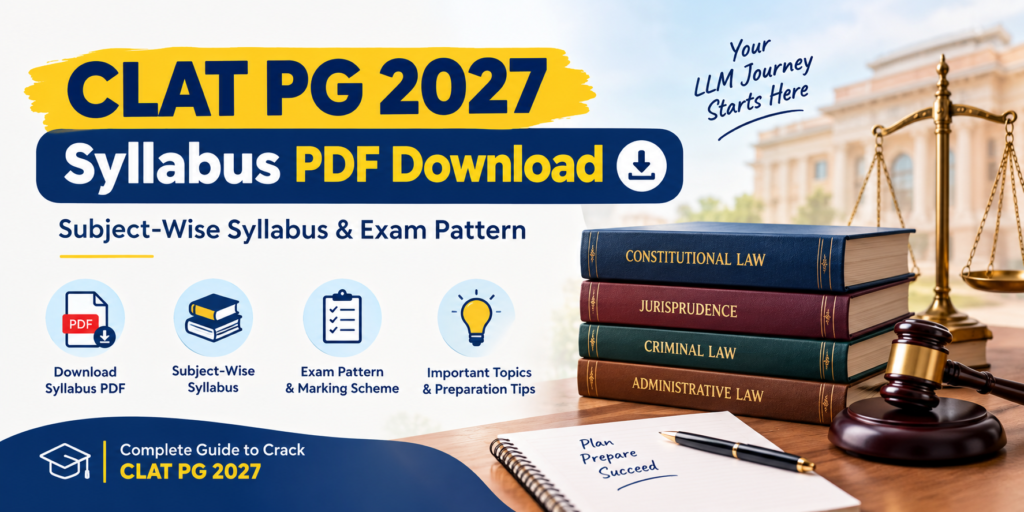
CLAT PG Syllabus 2027 PDF Download
Download the CLAT PG Syllabus 2027 PDF and explore the complete subject-wise syllabus, exam pattern, marking scheme and preparation strategy for CLAT LLM.
Download CLAT PG Syllabus 2027 PDFYou can download CLAT PG Syllabus 2027 PDF in this blog and it's for those students who aspire to clear the Common Law Admission Test to join postgraduate courses in law. The CLAT PG syllabus 2027 is framed keeping in mind the basic subjects taught in any undergraduate course in law and lays great stress on the knowledge of legal concepts through legal texts.
According to the Consortium of National Law Universities (NLUs), the CLAT PG 2027 test will consist of 120 objective type questions having 120 marks in total. The test duration will be 2 hours and the penalty for every wrong response would be 0.25 marks.
Constitutional Law is included in the CLAT PG official syllabus along with other subjects like Jurisprudence, Administrative Law, Contract Law, Torts, Family Law, Criminal Law, Property Law, Company Law, Public International Law, Tax Law, Environmental Law, and Labour & Industrial Law.
📄 CLAT PG Syllabus 2027 PDF Download
The aspirants searching for CLAT PG Syllabus 2027 PDF Download must go through the syllabus published by the Consortium of NLUs.
The syllabus outlines the concepts that will be asked in the examination as well as the abilities that will be in demand for answering questions based on legal text passages.
📥 Download CLAT PG 2027 Syllabus PDFCLAT PG Syllabus 2027: Highlights
| Particular | Details |
|---|---|
| Exam Name | Common Law Admission Test Postgraduate (CLAT PG) |
| Academic Session | 2027–28 |
| Programme | LL.M. |
| Exam Mode | Offline |
| Duration | 2 Hours |
| Total Questions | 120 |
| Maximum Marks | 120 |
| Question Type | Objective-Type Multiple Choice Questions |
| Marking Scheme | +1 for every correct answer |
| Negative Marking | -0.25 for every incorrect answer |
| Main Areas | Constitutional Law and Other Core Law Subjects |
| Medium | English |
CLAT PG Syllabus 2027: Subject-Wise
CLAT LLM Syllabus 2027 includes Constitutional Law along with other important legal subjects covered during the LL.B. course.
1. Constitutional Law
Constitutional law is an important subject on the CLAT PG syllabus. Students should study various parts of the Constitution including important legal principles, amendments, fundamental rights and significant court judgments.
- Historical background of the Indian Constitution
- Preamble
- Fundamental Rights
- Directive Principles of State Policy
- Fundamental Duties
- Constitutional remedies
- Judicial review
- Judicial activism
- Separation of powers
- Basic Structure Doctrine
- Constitutional amendments
- Union and State executive
- Parliament and State Legislatures
- Supreme Court and High Courts
- Centre-State relations
- Emergency provisions
- Constitutional authorities
- Writ jurisdiction
- Federalism
- Election-related constitutional provisions
Preparation Tip: Important Supreme Court rulings are incorporated in the CLAT PG exam since it uses extracts from rulings and legal sources of primary information.
2. Jurisprudence
Jurisprudence is concerned with the theoretical and philosophical foundations of law.
- Meaning and nature of law
- Schools of jurisprudence
- Natural Law School
- Analytical School
- Historical School
- Sociological School
- Realist School
- Legal rights and duties
- Ownership and possession
- Liability
- Justice
- Legal personality
- Sources of law
- Precedent
- Custom
- Law and ethics
Grasping concepts instead of merely memorising definitions can help students solve sentence-interpreting questions more effectively.
3. Administrative Law
Administrative Law deals with the powers and functioning of administrative authorities.
- Rule of law
- Separation of powers
- Delegated legislation
- Administrative discretion
- Principles of natural justice
- Judicial review of administrative action
- Administrative tribunals
- Ombudsman
- Writs
- Legitimate expectation
- Promissory estoppel
- Bias
- Reasoned decisions
4. Law of Contract
Candidates should revise the fundamental principles governing contracts and important provisions of contract law.
- Essentials of a valid contract
- Offer and acceptance
- Consideration
- Capacity to contract
- Free consent
- Coercion
- Undue influence
- Fraud
- Misrepresentation
- Mistake
- Legality of object
- Void agreements
- Contingent contracts
- Performance of contracts
- Discharge of contracts
- Breach of contract
- Remedies for breach
- Indemnity
- Guarantee
- Bailment
- Pledge
- Agency
5. Law of Torts
The Torts section tests understanding of civil wrongs and the principles governing liability.
- Nature and essentials of tort
- Negligence
- Nuisance
- Defamation
- Trespass
- Strict liability
- Absolute liability
- Vicarious liability
- State liability
- General defences
- Damages
- Consumer-related principles
6. Family Law
Family Law is another important area included in the CLAT PG syllabus.
- Marriage
- Divorce
- Maintenance
- Adoption
- Guardianship
- Succession
- Joint Hindu Family
- Coparcenary
- Hindu Marriage Act
- Hindu Succession Act
- Hindu Adoption and Maintenance Act
- Muslim Law of marriage and divorce
- Inheritance and succession
- Personal laws
7. Criminal Law
The Criminal Law portion requires candidates to understand the basic principles of criminal liability and offences.
- General principles of criminal liability
- Mens rea
- Actus reus
- General exceptions
- Abetment
- Criminal conspiracy
- Attempt
- Common intention
- Common object
- Offences against the human body
- Offences against property
- Defences in criminal law
- Punishments
- Important criminal law judgments
Important: Candidates should also pay attention to the current statutory framework applicable to the examination.
8. Property Law
- Meaning and classification of property
- Transfer of property
- Conditions and restrictions on transfer
- Sale
- Mortgage
- Lease
- Exchange
- Gift
- Actionable claims
- Doctrine of election
- Doctrine of lis pendens
- Part performance
- Rule against perpetuity
9. Company Law
- Incorporation of companies
- Types of companies
- Memorandum of Association
- Articles of Association
- Prospectus
- Share capital
- Directors
- Meetings
- Corporate governance
- Company management
- Oppression and mismanagement
- Corporate liability
- Winding up
10. Public International Law
- Nature and sources of international law
- State recognition
- State succession
- State responsibility
- Treaties
- International organisations
- United Nations
- International disputes
- Jurisdiction
- Extradition
- Asylum
- Law of the sea
- International humanitarian principles
11. Tax Law
- Basic concepts of taxation
- Direct and indirect taxes
- Income tax principles
- Taxable income
- Residential status
- Tax liability
- Constitutional provisions relating to taxation
- GST fundamentals
- Important judicial decisions relating to taxation
12. Environmental Law
- Environmental protection principles
- Sustainable development
- Polluter Pays Principle
- Precautionary Principle
- Public Trust Doctrine
- Environmental impact assessment
- Environmental protection legislation
- Forest and wildlife protection
- Pollution control
- Important environmental judgments
13. Labour and Industrial Law
- Industrial disputes
- Trade unions
- Strikes and lockouts
- Retrenchment
- Lay-off
- Closure
- Industrial adjudication
- Employment conditions
- Social security
- Wages
- Important labour-law legislation
CLAT PG 2027 Question Paper Pattern
The CLAT PG 2027 exam consists of 120 multiple-choice questions carrying 120 marks. Different from conventional subject-based question papers, this paper consists of excerpts from the main legal documents.
The questions test a candidate's ability to:
- Read and comprehend the issues discussed in a passage
- Understand legal issues and facts connected with the passage
- Summarise the passage
- Apply knowledge of the relevant area of law
Therefore, simply memorising large numbers of legal provisions may not be sufficient. Candidates should also develop the ability to read a legal passage carefully and identify the legal principle being tested.
CLAT PG 2027 Marking Scheme
| Response | Marks |
|---|---|
| Correct Answer | +1 |
| Incorrect Answer | -0.25 |
| Unattempted Question | 0 |
How to Prepare for CLAT PG Syllabus 2027
01. Start with the Official Syllabus
Get a copy of the CLAT PG Syllabus 2027 PDF and compile a list of all the topics.
02. Reinforce Constitutional Law
Study significant constitutional provisions along with landmark decisions and doctrines.
03. Revise Core LL.B. Subjects
Prepare Jurisprudence, Contract, Tort, Criminal Law, Family Law, Property Law, Company Law and other syllabus areas.
04. Read Landmark Judgments
Focus on facts, issues, legal provisions, arguments, ratio decidendi, decisions and principles.
05. Study Bare Acts
Focus on understanding significant statutory provisions rather than memorising every provision.
06. Solve Passage Questions
Practise reading legal passages and identify the central legal issue being tested.
07. Refer to Previous Papers
Previous years' papers help students understand passage style and application-based questions.
08. Take Mock Tests
Regular mock tests can improve reading speed, time management, accuracy, question selection and elimination skills.
Important Books and Study Resources for CLAT PG
Candidates can use a combination of standard LL.B. textbooks, Bare Acts, landmark judgments, previous-year question papers and mock tests.
- Constitutional Law textbook
- Jurisprudence textbook
- Contract Law textbook
- Law of Torts textbook
- Criminal Law textbook
- Family Law textbook
- Property Law textbook
- Company Law textbook
- Administrative Law textbook
- Bare Acts
- Landmark Supreme Court judgments
- CLAT PG previous-year question papers
- CLAT PG mock tests
CLAT PG Syllabus 2027 vs CLAT UG Syllabus
The syllabi in CLAT UG and CLAT PG differ from each other.
| CLAT UG | CLAT PG |
|---|---|
| For 5-year integrated LL.B. programmes | For LL.M. programmes |
| Five major sections | Constitutional Law + other core law subjects |
| English Language | Jurisprudence |
| Current Affairs including GK | Contract |
| Legal Reasoning | Torts |
| Logical Reasoning | Criminal Law |
| Quantitative Techniques | Family Law |
| Basic mathematical skills | Property Law |
| Reading and reasoning skills | Company, Tax, Environmental and Labour Law |
Frequently Asked Questions About CLAT PG Syllabus 2027
Did the syllabus of CLAT PG 2027 get released?
Yes, the syllabus of CLAT PG 2027 has been released on the CLAT 2027 portal by the Consortium of NLUs.
How many questions would be there in CLAT PG 2027?
The test of CLAT PG 2027 comprises 120 objective-type questions carrying one mark each.
What is the time limit for the CLAT PG examination?
CLAT PG 2027 has a time limit of 2 hours.
Is there any penalty for wrong answers in the CLAT PG exam?
Yes. 0.25 marks will be subtracted for every wrong answer.
What subjects are part of the CLAT PG syllabus?
CLAT PG syllabus consists of Constitutional Law, Jurisprudence, Administrative Law, Contract Law, Tort Law, Family Law, Criminal Law, Property Law, Company Law, Public International Law, Taxation Law, Environmental Law, and Labour and Industrial Law.
Is the concept of law important in the CLAT PG exam?
Yes. Since Constitutional Law is part of the syllabus, students should give importance to provisions, theories, major court judgments and changes in law that may be relevant to the examination.
Does the CLAT PG exam contain passage-based questions?
Yes. The CLAT PG examination includes questions based on passages and legal texts.
Download CLAT PG Syllabus 2027 PDF
Use the syllabus to organise your preparation, divide the subjects into manageable sections and practise legal passages, important judgments and core LL.B. subjects.
Download PDF